

Leave your details and our team will get in touch.
Request a call back
Waterproof Render in Croydon
Help protect your walls from damp, driving rain and cold.
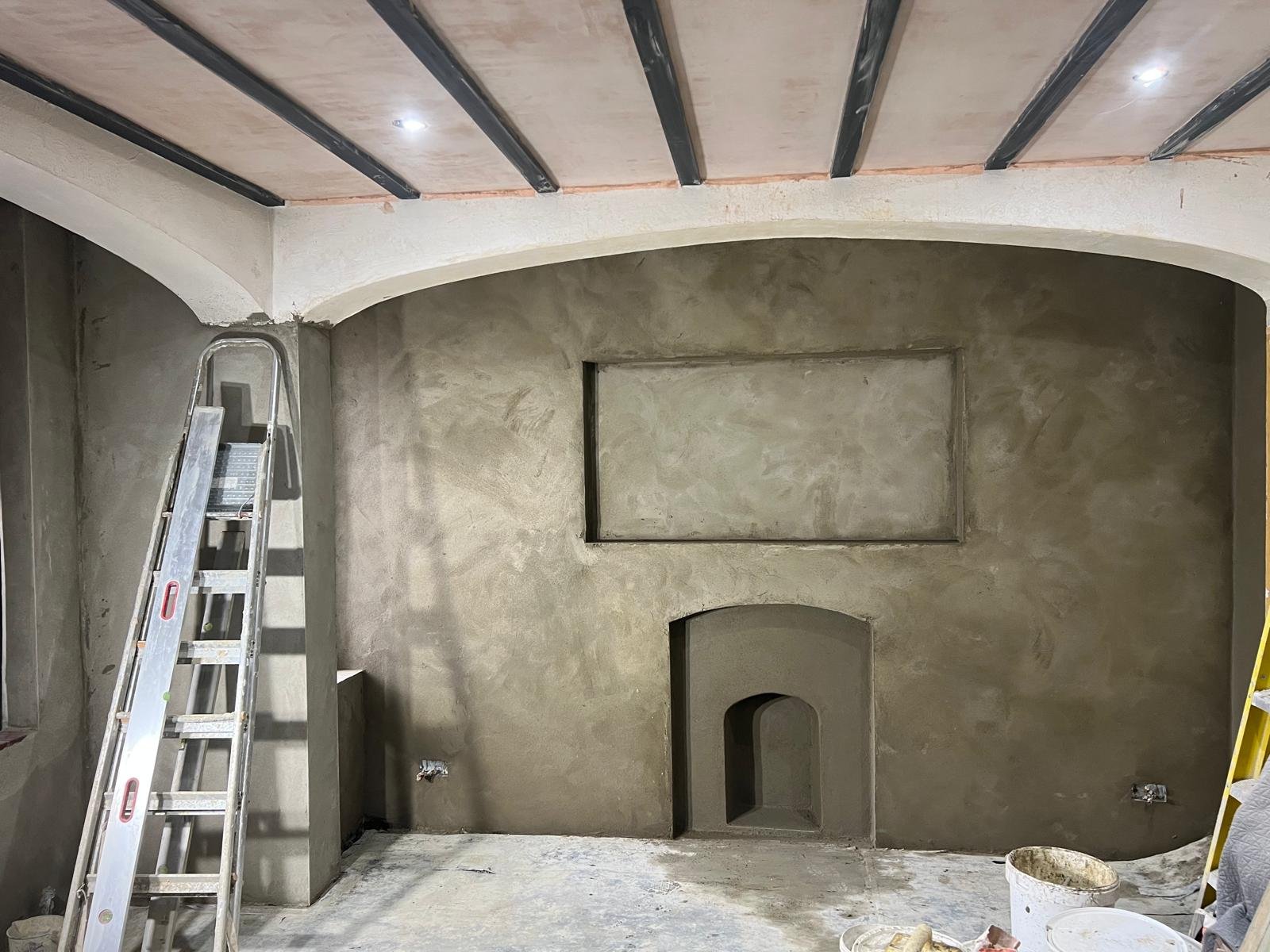
More than a surface finish, waterproof render forms a protective layer over masonry. No render is 100% waterproof by itself, but a suitable system, applied properly, protects most of the wall beneath against moisture, frost damage, cracking, mould and damp patches. Add waterproofing slurry underneath and the layers form a complete barrier against water.
At Crystal Damp Proofing & Basements Ltd, our CSSW-qualified team applies waterproof render in Croydon CR0 to interior and exterior walls, choosing a system to suit the building.
How is render made water-resistant?
Specialist additives mixed into the render enter the material’s pores and bond to form an internal protective coating. This substantially reduces water absorption. We select from these options according to the wall’s position and conditions:
- Cement renders with waterproofing additives: a strong, watertight choice for highly exposed areas and interior basement walls.
- Silicone renders: repel water effectively, allowing rain to run off and take dirt with it.
- Acrylic renders: combine low water absorption with flexibility and weather resistance.
- Mosaic (resin) renders: resist water and impact particularly well and are commonly used on plinths.
- Renovation renders: allow old, damp walls to breathe while resisting salts.
Why protect walls with waterproof render?
A suitable waterproof render system helps shield walls from:
- Driving rain and splashback: rain striking the wall or splashing up from the ground.
- Rising and penetrating damp: moisture entering masonry from below (rising damp) or passing through a wall (penetrating damp).
- Frost damage: trapped water can freeze and expand, cracking render and masonry.
- Cold and heat loss: a dry wall insulates much more effectively than a wet one.
- Mould, algae and moss: persistent moisture encourages growth on indoor and outdoor surfaces.
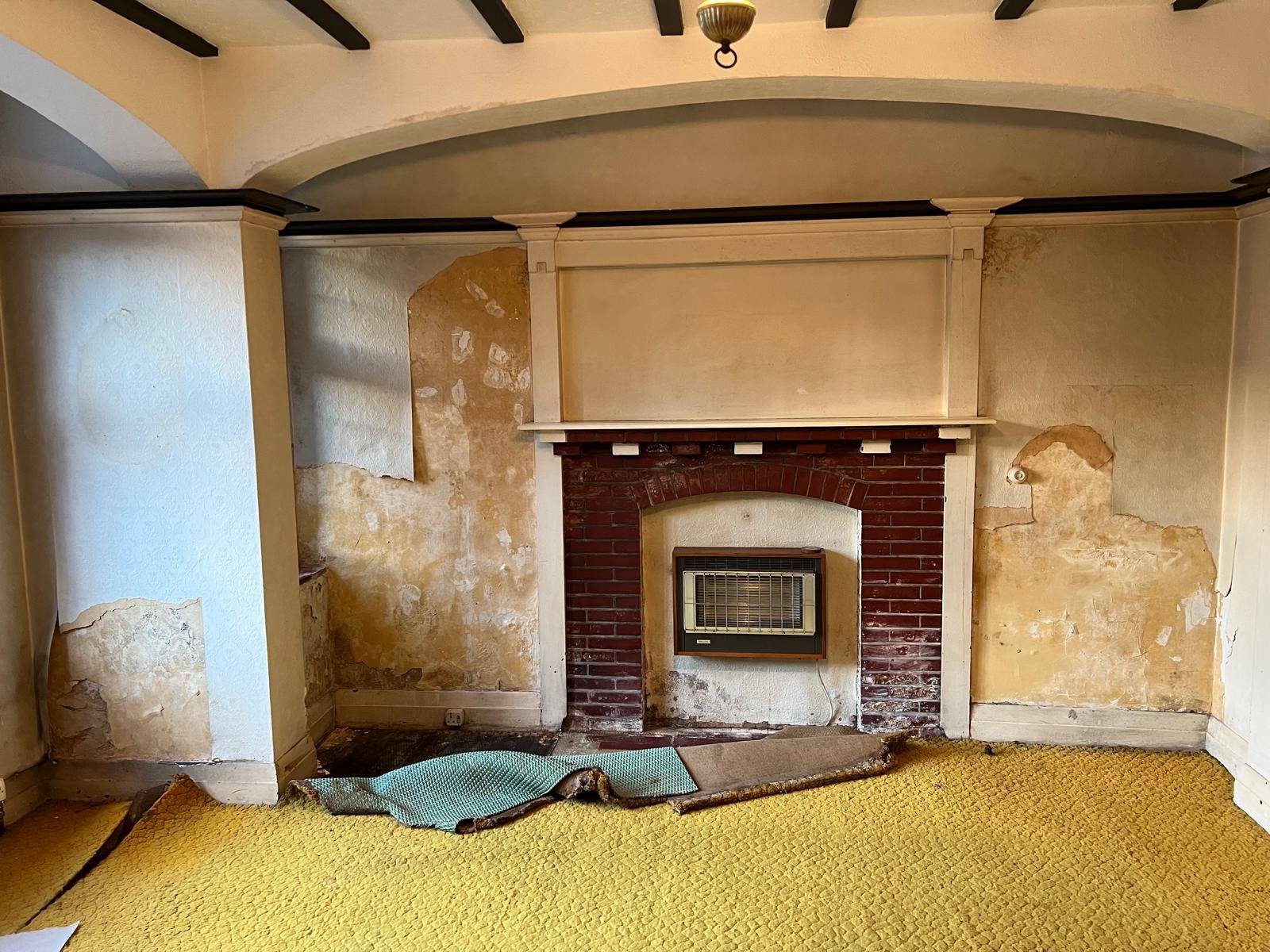
Before rendering
Suitable walls
Where can waterproof render be used?
Inside or out, waterproof render is useful where walls are especially exposed to water.
Outside the building
- Plinths and lower walls: the bottom 30–50 cm of a façade, where rain splashes up and snow can lie.
- Foundation and basement areas: walls touching the ground, either without full vertical waterproofing or needing additional protection. See retaining wall and foundation waterproofing.
- Exposed walls: elevations facing wind-driven rain, or slower-drying walls prone to algae.
- Around terraces, balconies and entrances: places where runoff or splashback from level surfaces reaches the render.
- Near water and trees: buildings beside rivers, lakes or woodland, where the surrounding air stays humid.
Inside, and on old walls
- Old, damp walls: as part of restoring masonry affected by moisture.
- Interior walls: including basements, cellars and other damp-prone rooms.
Does mortar need repairing before rendering?
Yes. The render needs sound masonry behind it. We rake out loose or crumbling mortar and repoint to a depth of at least 20 mm; cracks must also be repaired before rendering. Preparing that stable base is essential to effective waterproofing.
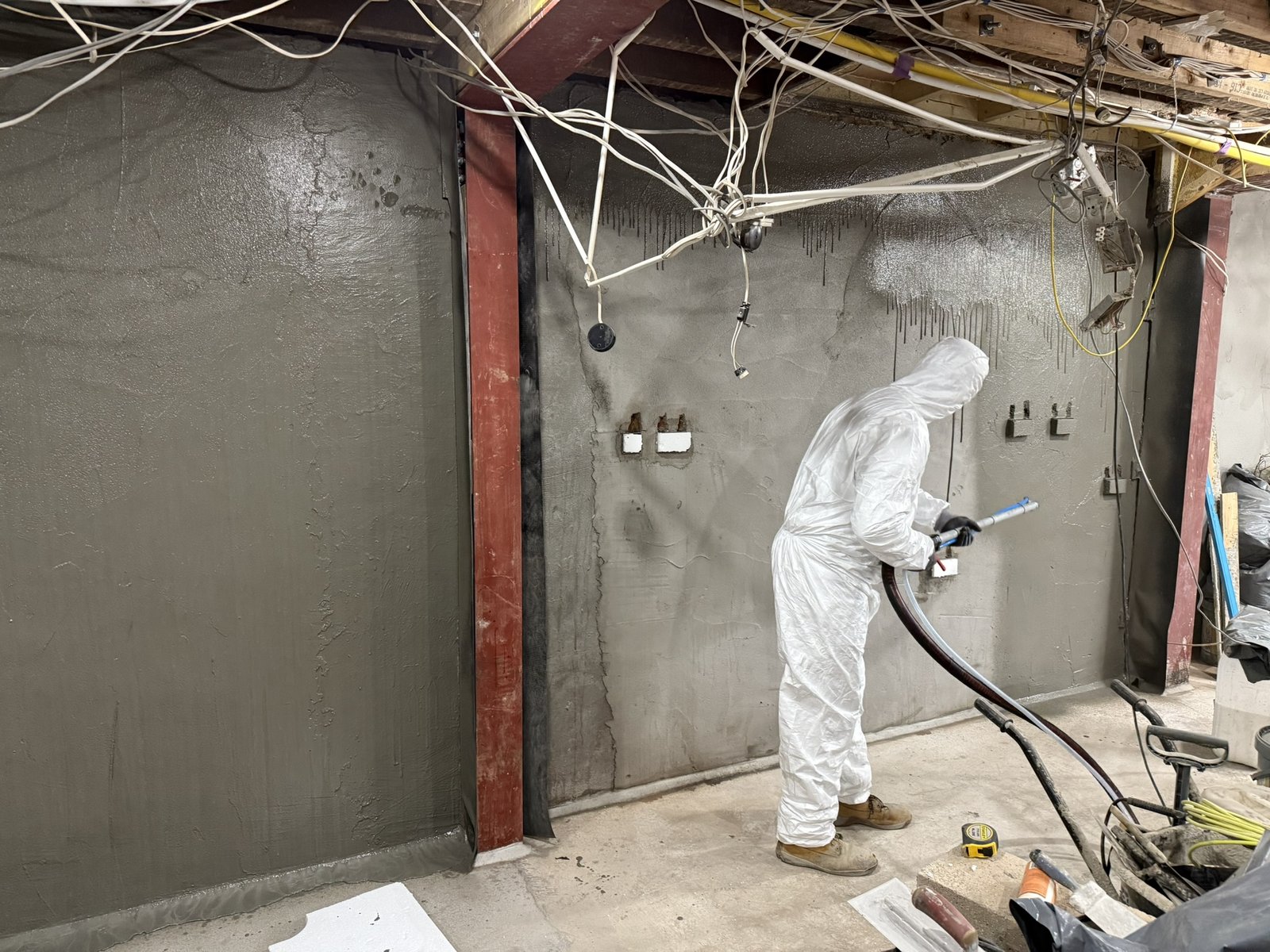
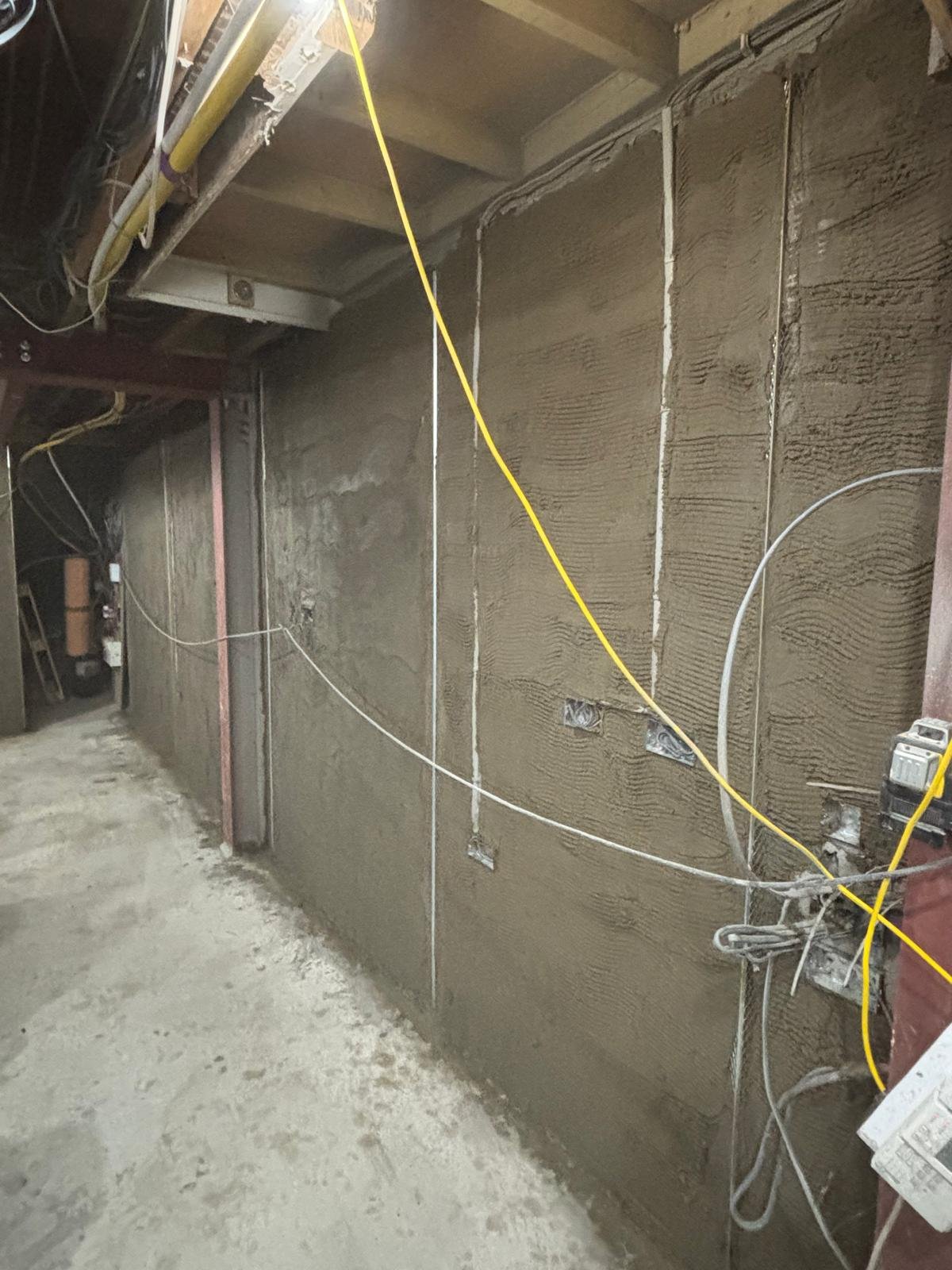
Sprayed tanking slurry
Preparing basement walls with spray-applied tanking
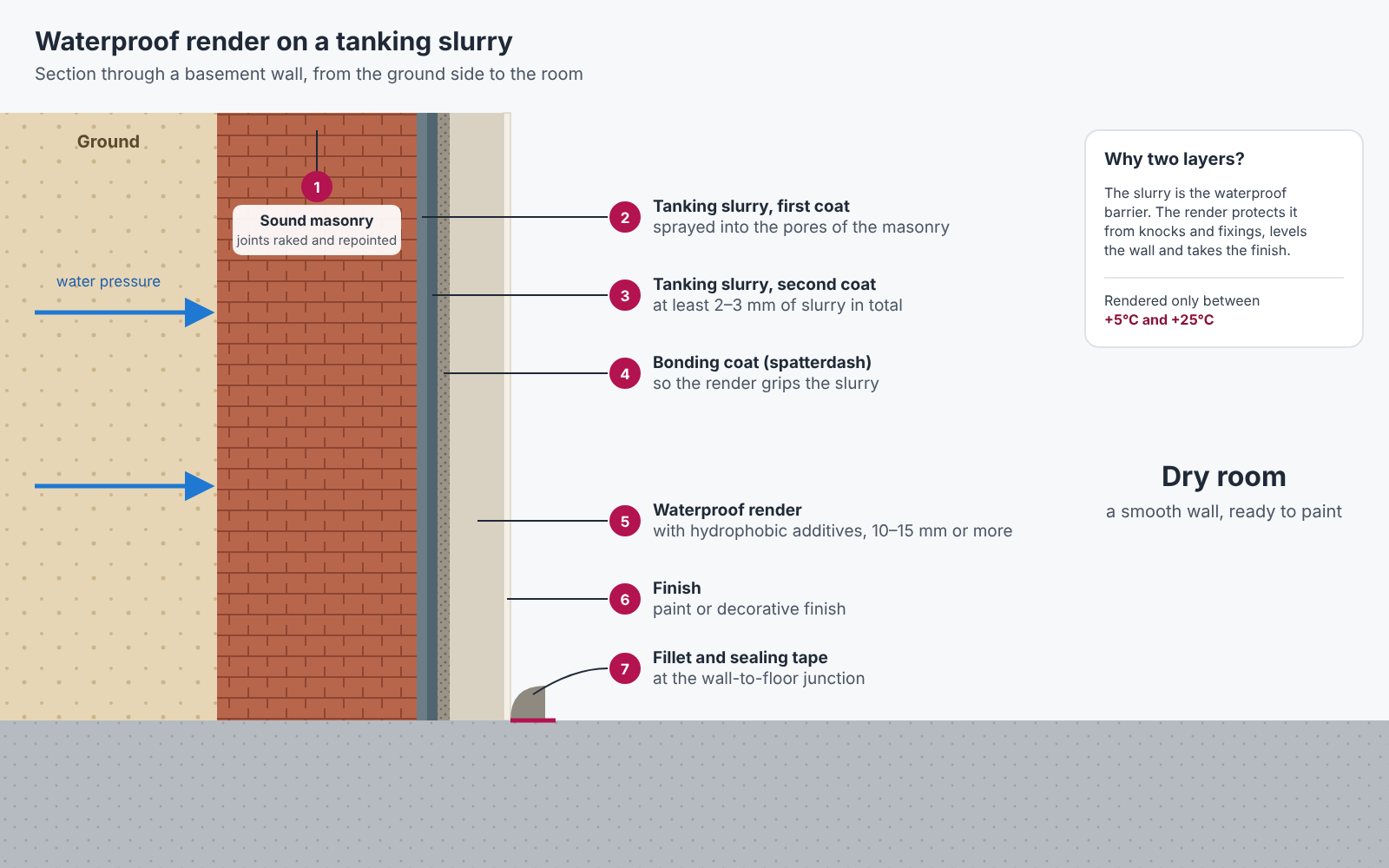
For basement and cellar walls, we apply spray-applied tanking before rendering. The slurry is a polymer-modified, mineral cement waterproofing mortar. Sprayed by machine in at least two coats, around 2–3 mm thick in total, it bonds permanently to the masonry to form a seamless, watertight barrier against ground moisture and water pressure.
Compared with hand application, spraying offers these advantages:
- No weak spots: spray reaches the pores, hollows and irregular surfaces of brick, stone and concrete that a brush or trowel might leave thin or uncovered.
- One seamless coat: without joints or overlaps that could provide a route for water.
- Even coverage and speed: a consistent layer across corners and behind services, applied much faster than by hand.
Slurry beneath render
How tanking slurry and waterproof render work together
Slurry and render serve different purposes; combining them provides more protection than using either layer alone.
A smooth, ready-to-finish wall: render evens out the surface and provides a firm base for paint or another finish, making the basement feel like another room in the home.
Building the layers
Applying waterproof render over tanking slurry
On basement and cellar walls, we normally build up a layered system. The tanking slurry blocks water; the render above it protects the barrier, smooths the wall and supports the final finish.
Important rules and avoidable mistakes
- The right order: for internal basement waterproofing, slurry belongs beneath the render, on the side from which the water comes.
- Corners and junctions: sealing tape is embedded in the slurry where walls meet each other or the floor, as movement can cause cracks there.
- Curing: we lightly mist the slurry and render for the first few days and shield them from drying too fast in sunshine or draughts.
- Too thin a layer: less than 2 mm of slurry will not provide full waterproofing.
- The wrong conditions: rendering takes place only between +5°C and +25°C, without rain or strong wind, and never on a soaking wet wall.
Check the moisture first
Is the wall damp, or is water pressing in?
Understanding how water affects the room determines which system is suitable.
Damp walls and rising damp
Ground moisture moves upwards through masonry. You may see salts and feel dampness on the wall, without water actually running in.
Standing water or water pressing in
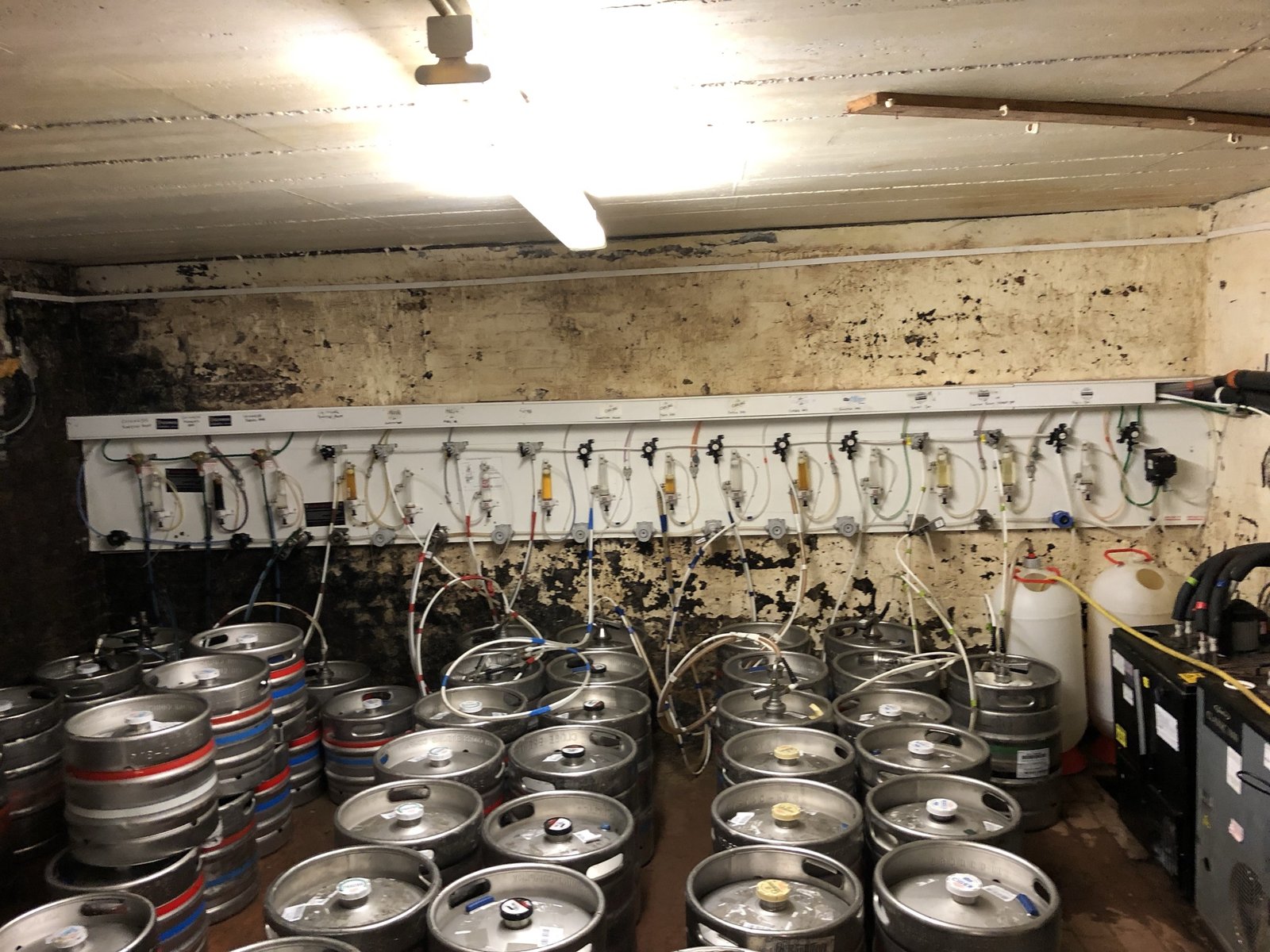
When water stands against an outside wall, it pushes towards the room. This negative pressure can force ordinary waterproof render and standard flexible slurry away from the masonry, leaving blisters rather than holding back the water.
Our approach when water presses in
- Stopping active leaks first: we cut seeping or spurting points into a dovetail shape, then seal them with fast-setting hydraulic cement that sets in seconds on contact with water.
- Back to sound masonry: old render is removed at least 80 cm above the visible damp line, ideally up to the ceiling in basements, and salt deposits are wire-brushed away.
- Fillets at the wall-to-floor junction: we use repair mortar to form a rounded fillet of around 4–5 cm radius where water pressure is greatest.
- Rigid mineral slurry: a product designed for negative pressure, often using crystalline technology, applied in at least 2–3 coats to at least 3 mm thick once cured.
- Render on top: we follow with a bonding coat and render appropriate to the conditions.
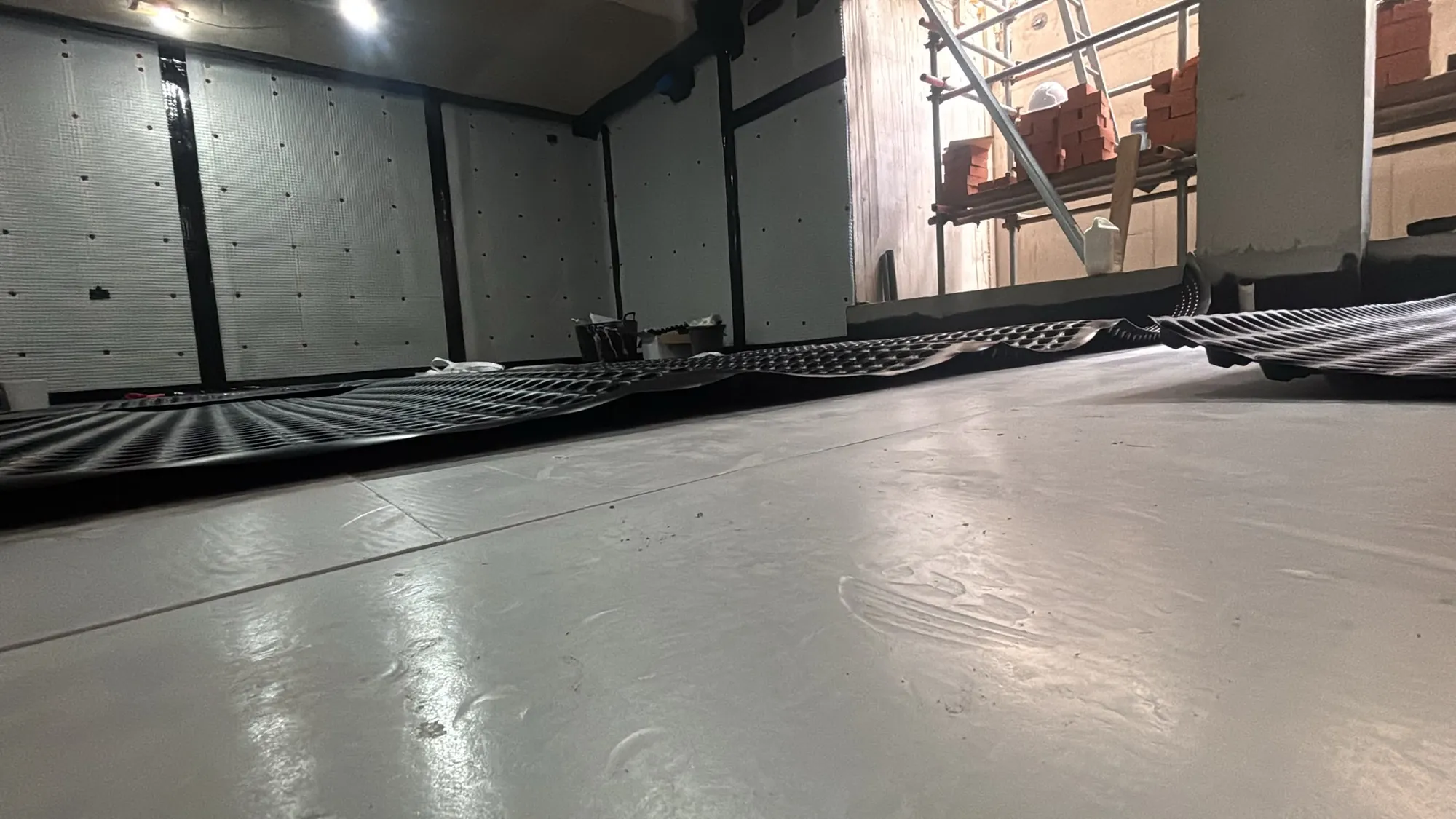
Constant, high-pressure water can make slurry and render alone insufficient for a dry, habitable room. In line with BS 8102, we then recommend a cavity drain membrane system (Type C), drainage and a sump pump. Our basement waterproofing page explains this approach.
When Type C is needed
Older walls with salts
Renovation render for salts and rising damp
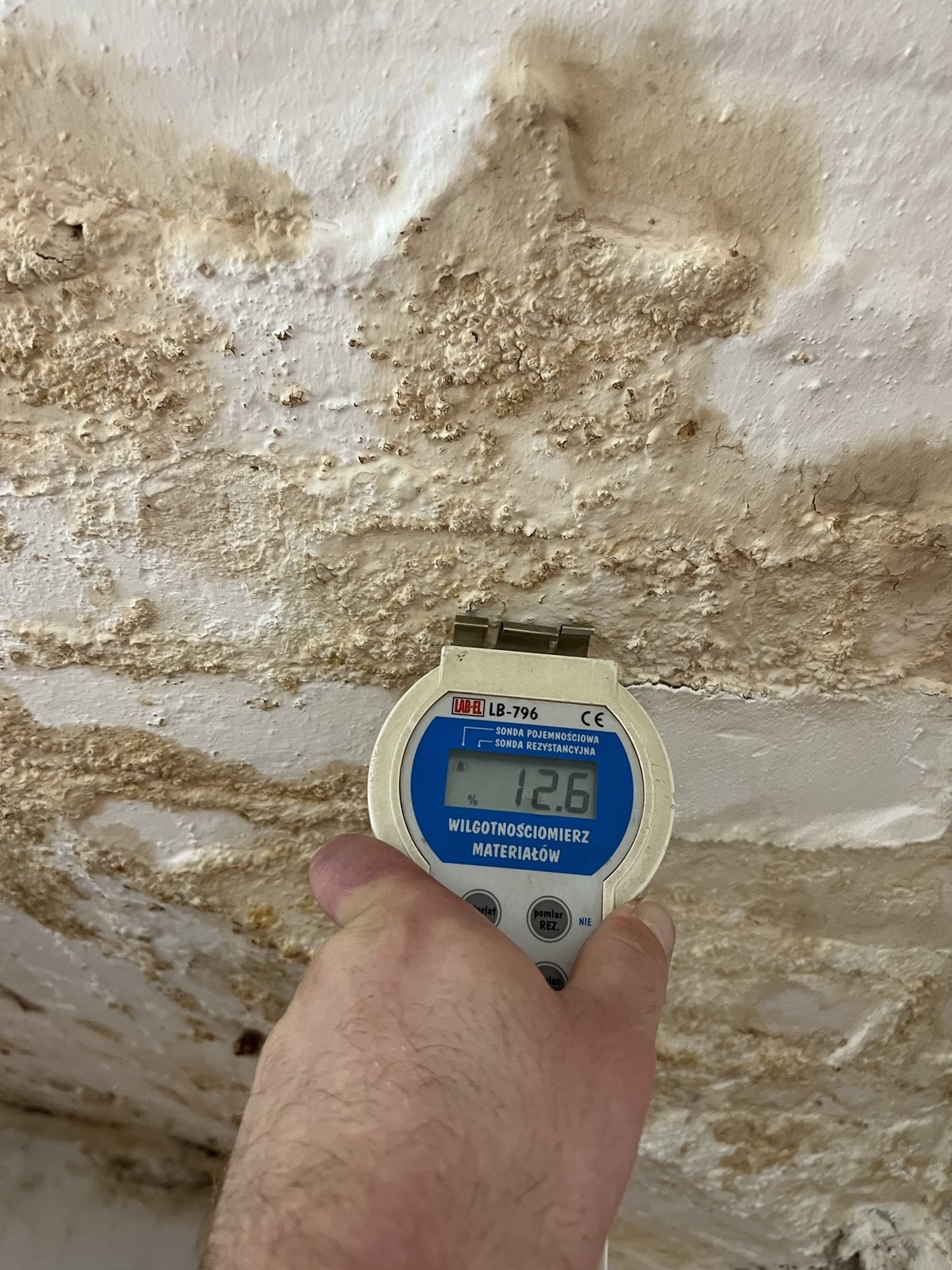
On walls affected by salts and rising damp, ordinary waterproof render can trap moisture. Salts then build up behind it and push the render away.
Renovation render system
- Bonding coat: we start with a semi-covering renovation spatterdash coat.
- Renovation render: next comes porous, air-entrained renovation render at least 20 mm thick.
How it works: numerous tiny pores let residual moisture escape as the wall breathes. Damaging salts crystallise within those pores rather than breaking up the rendered surface.
Addressing rising damp in the masonry
Internal slurry can prevent rising moisture from reaching the room, but it does not dry the wall within: moisture can remain inside the masonry.
To stop the rise of moisture at its source, we recommend a DPC injection. Holes drilled into the wall receive a specialist cream or silane-based fluid, creating a water barrier within the masonry.
Where will the water go?
Need a sump chamber? We can help install one
If water is standing on the floor, it needs a route out before we waterproof the room. Where there is no sump chamber, we can help put one in.
- Sump chamber at the lowest point: installed within the floor, with an automatic sump pump to discharge water outside the building.
- The right discharge point: water goes to a foul or combined sewer through a trapped gulley to prevent smells returning, or to a surface water drain through a non-return valve.
- Back-up protection: a battery back-up (UPS) or generator runs the pump during a power cut; with twin pumps, the second starts if the first fails.
- Regular servicing: we recommend pump servicing twice a year, including cleaning the chamber, checking the float switch and testing automatic operation.
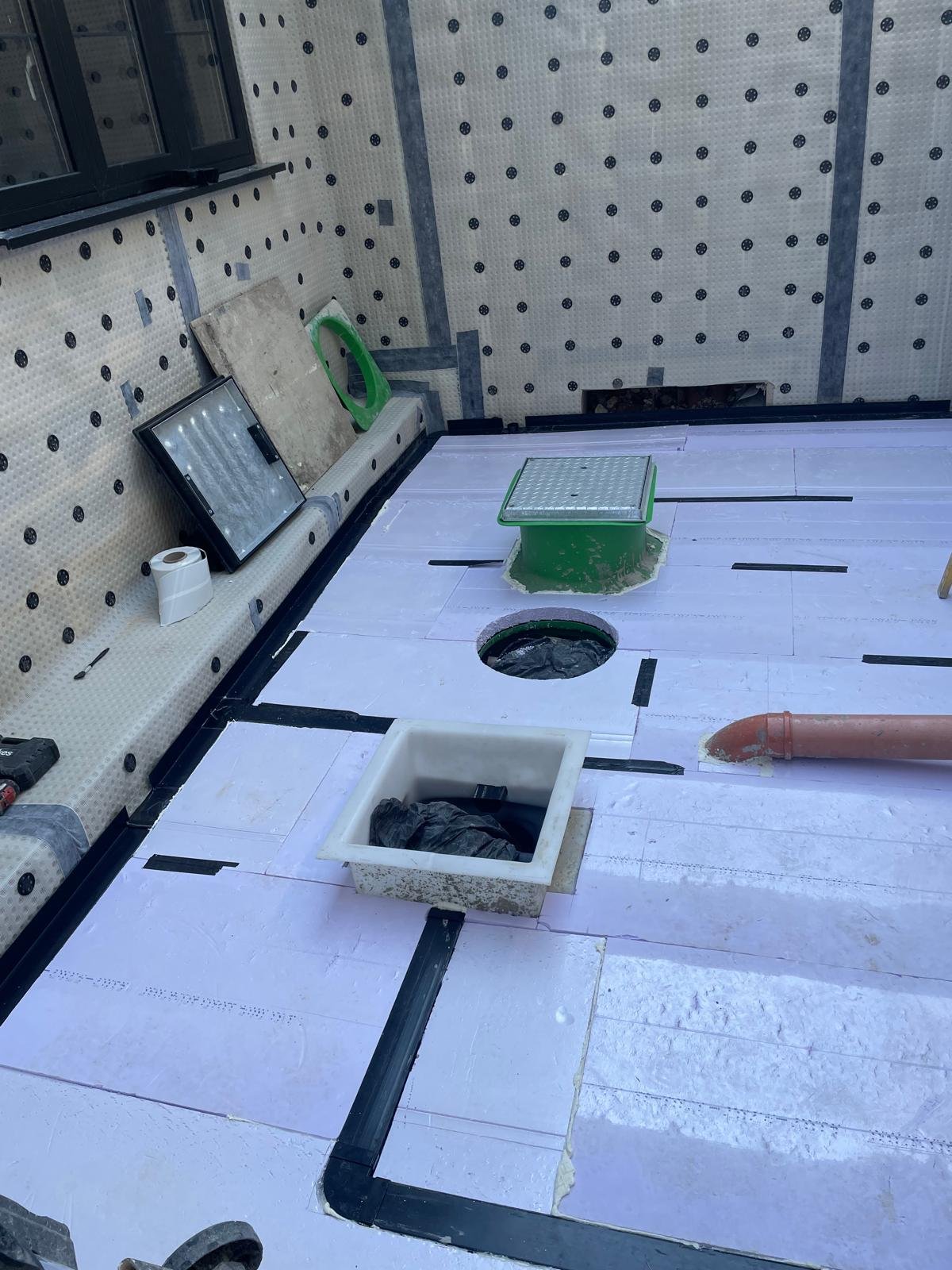
Our materials
Trusted manufacturers & high-quality materials
Our systems use established products from manufacturers including Newton, Wykamol, Delta, Biokil and Mapei. Used together, the materials provide lasting protection for your walls.
NEWTON
Newton
Slurries and membranes for waterproofing.

Wykamol
Slurry, additives and products for renovation.

Delta
Drainage channels, membranes and sump pumps.

Biokil
Products for damp proofing and mould treatment.

Mapei
Mortars, renders and materials for waterproof repairs.
Related work
Services that complement waterproof render
Depending on the wall, rendering may form part of a wider solution, including spray-applied tanking or full basement waterproofing.
Spray-Applied Basement Waterproofing
Tanking slurry applied beneath render.
Basement Waterproofing
Tanking, membranes and pumps.
Cellar Waterproofing
Keeping older cellars dry.
Rising Damp
Moisture travelling up from the ground.
Penetrating Damp
Moisture passing through walls.
Crystalline DPC Injections
Creating a damp proof course in walls.
Structural Cracks Repair
Repairing cracks before rendering.
Retaining Wall & Foundation Waterproofing
Protection for walls retaining soil.
Sump Pump System & Services
Pumping collected water away.
ISO-Therm Membrane & Black Mould
Addressing mould and condensation.
Basement Waterproofing Technology
Understanding Type A, B and C.
Insurance-Backed Guarantee & Product Warranty
Cover transferable when the property is sold.
Your questions
Waterproof render questions answered
Is waterproof render completely waterproof?
Not by itself: no render is 100% waterproof. Additives greatly limit water absorption and help protect most of the masonry beneath. With tanking slurry underneath, the system forms a complete barrier against water.
Which type of waterproof render do I need?
The answer depends on the wall and its exposure. Cement render with waterproofing additives suits exposed areas and basement walls; silicone sheds rain and resists algae; acrylic offers flexibility and weather resistance; mosaic protects plinths; and renovation render suits older, salt-affected walls. We recommend a system after surveying the wall.
Do you repair the mortar before rendering?
Yes. A sound wall is essential. We rake out and repoint loose or crumbling mortar to a depth of at least 20 mm, and repair cracks before applying render.
How thick are the slurry and render layers?
We apply tanking slurry in at least two coats, totalling at least 2–3 mm. Waterproof render above it is at least 10–15 mm thick; renovation render is at least 20 mm thick.
Can you render a basement wall where water is pressing in?
Yes, if the system suits the conditions. We plug active leaks with fast-setting hydraulic cement, apply rigid mineral slurry designed for negative pressure to at least 3 mm thick, then render. For constant, high-pressure water, we recommend a cavity drain membrane system (Type C) in line with BS 8102.
Why use renovation render on walls with rising damp?
Its porous, air-entrained structure lets the wall breathe while salts crystallise inside the render’s pores instead of damaging its surface. A breathable mineral paint or coating completes the finish. We recommend DPC injection to stop rising damp at its source.
When can render be applied?
We render only between +5°C and +25°C, without rain or strong wind, and not on a soaking wet wall. During the first few days, we lightly mist slurry and render and protect them against drying too rapidly.
How do I book a survey in Croydon?
Book online or call our specialists on 020 8432 3350 or 07720 752231. We will inspect your walls and recommend an appropriate interior or exterior render system.
Arrange a survey
Arrange a wall survey in Croydon
Damp or cracked walls, blown render or water entering your basement? Book a survey or speak to our specialists on 020 8432 3350 or 07720 752231.
07720 752231
Describe your walls
Please complete the fields marked *. When we receive your details, we will contact you to arrange a survey.
Local considerations
What we assess before rendering walls in Croydon
Across Croydon, older terraces and newer buildings can present very different walls. Rather than assume a render will suit every property, we examine the particular masonry and its condition before choosing a system.
We assess exposure to rain, mortar condition and cracks, signs of salts or rising damp, and any water pressing into the wall. This guides the preparation and choice of render, including whether tanking slurry is required underneath.
Accountable for the rendering we carry out
We stand behind the render we apply and put right any defect in our work.
Our own qualified team carries out every project, so you know who completed the work and who is responsible for it. We also provide waterproof render in Norbury, Mitcham and Purley.
Work by our own team
Damp or blown render? Talk to us about your walls
Our 5-star Google rating is a source of pride. Book a survey, see what customers say in our reviews, or call our specialists on 020 8432 3350.
Qualified Specialists & a 10-Year Guarantee
Our family-run team holds CSSW qualifications, with a minimum of 10 years’ experience each. We back every job in Croydon with a 10-year guarantee covering workmanship, plus a QANW Insurance Backed Guarantee that transfers to the new owner if you sell your property. We work on domestic and commercial properties in Croydon and across London and the South East.

See What Our Clients Say
★★★★★ Rated 5 stars on Google
We are proud of our 5-star Google rating: see our reviews. If your basement or property in Croydon is damp or takes in water, book a survey in our Booking Survey section, or call or message our fully qualified advisors.
Where we work
Waterproof render across Croydon and nearby
For interior and exterior walls, Crystal Damp Proofing & Basements Ltd applies waterproof render in Croydon and nearby areas including Norbury, Mitcham and Purley. Select an area below for its local page.